
Building the payload. Shaping the experiment.
Explore the team's radiation figures, the Fall flight report, payload fabrication work and named student researchers. Each semester keeps its own presentation and results.
Explore this year’s flight record
- Archive
- Fall flight report + design record
- Research
- Symposium abstract verified
- People
- Named presenters documented
The Fall launch-acquired-data report adds atmospheric and radiation figures to the year's engineering archive. The Spring symposium abstract documents its earlier research agenda separately.
Radiation through ascent and descent
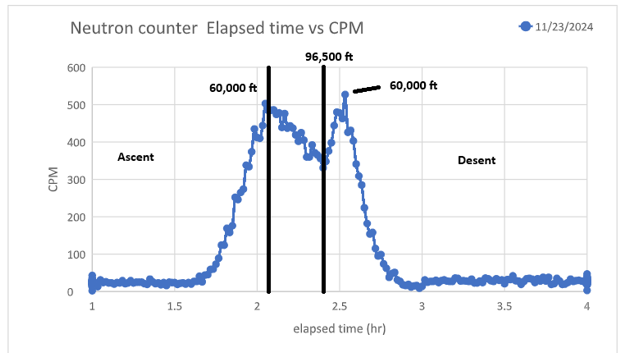
November 23, 2024
The original figure plots counts per minute against elapsed time, with ascent, descent and altitude markers. It is retained as a 2024 record because its printed date is 11/23/2024—even where later display prose labels it differently.
This is a time profile: its width reflects how long the vehicle spent crossing the atmosphere. The broader ascent and narrower descent do not, by themselves, establish a different instrument sampling rate. Counts per minute are detector counts, not a radiation-dose measurement.
Read the Fall 2024 presentation figures →Structure, sensing, and cooling
The team described improving fabrication and component standardization for a carbon-fiber-reinforced vehicle. Light sensors were being integrated to study altitude-dependent readings and vehicle behavior. A prelaunch cooling mechanism had been developed and implemented.
Radiation and a steadier view
The abstract proposed beta/gamma and neutron measurements across altitude to investigate the Pfotzer–Regener maximum. Video work focused on stabilization and an upward-looking camera.
These are documented objectives, not published measurement results or a claim that every instrument flew successfully.
Inside the build
The 2024 recruitment deck outlined practical work across the payload: CAD and fabrication, embedded electronics, and video.
Mechanical
Fusion 360 modeling, 3D printing, and carbon-fiber molding.
Electronics and software
PCB and schematic work, battery and power distribution, Arduino, and C++.
Imaging
Video stabilization, 360°/VR editing, and equipment testing.
Its payload constraints included a three-pound limit, temperatures down to −70°F, impact, dependable power, and camera cooling. These describe historical design challenges, not verified qualification tests or current program requirements.
Source: team-supplied 2024 recruitment presentation, slides 4–6. The original deck remains a private team record.
Named symposium presenters
- Lorynn Garcia
- Garret Nordmeyer
- Nathaniel Okafor
- Rafael Sanchez
- Ryan Schmidt
Faculty mentor: Eddie Ong.
The symposium program identifies these presenters. This is not a complete semester or flight roster.
Students and mentors together
The Fall photograph has its own left-to-right people caption, separate from the Spring symposium presenter record.
Faculty mentors: Dr. Eddie Ong · science and Ernest Villicaña (Mr V) · engineering.
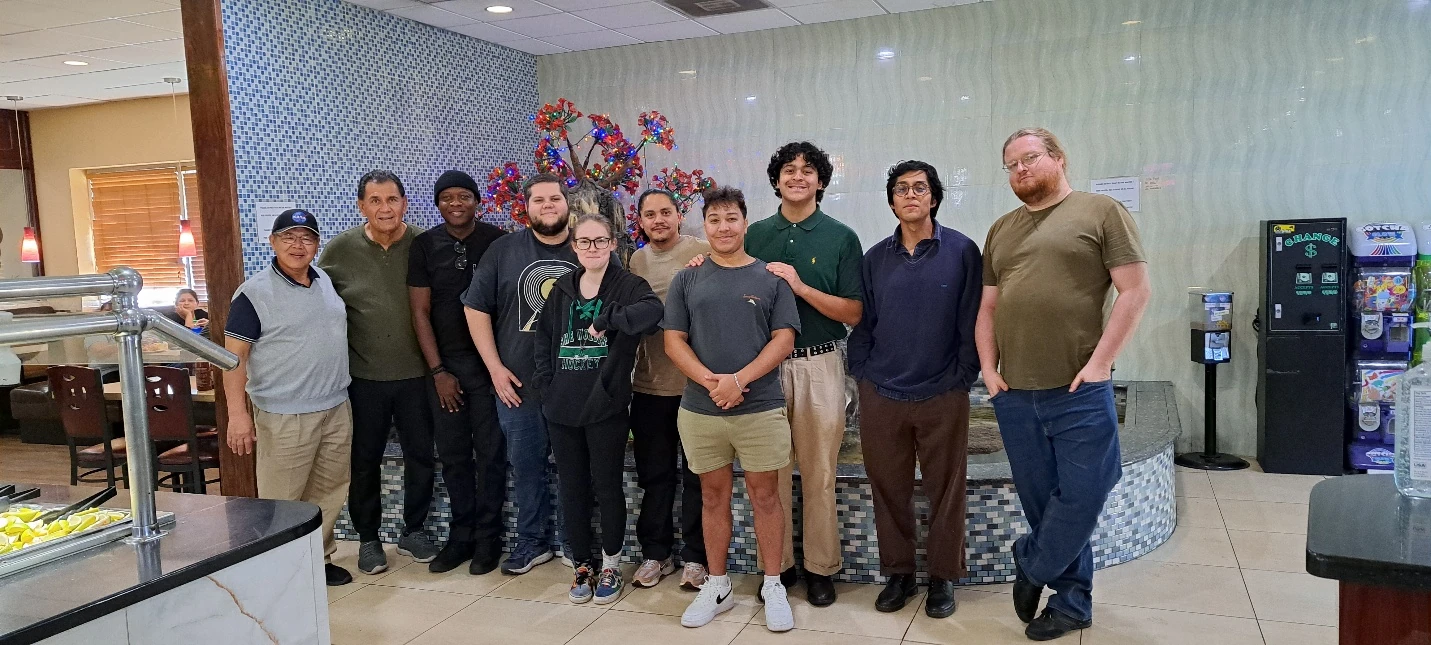
Fall 2024 · Team photograph
From left to right: Ed Ong, Ernest Villicana, Nate Okafor, Adam Fuge, Angela Trainor, Marquiz Muza, Ryan Schmidt, Elvis Garcia, Garrett Nordmeyer.